Histamine and seasonal allergies (hay fever)
Spring has sprung. The sun is shining (YAY), skies are blues and nature is blooming. However for those of us who struggle with hay fever, this time of year has its challenges.
Nutritional therapy can be incredibly powerful when it comes to understanding why you might struggle with hay fever more than others, and, practical nutrition tips to help reduce symptoms.
Histamine and hay fever
Hay fever is a histamine meditated response and is your body’s immune system reacting to particles (from trees, pollen) in the air. As part of this immune process, histamine is realised from the mast cells; this is a normal part of the immune response and the histamine itself isn’t necessarily the problem. It’s often when histamine is produced at a rate that’s too quick for the body to be able to break it down and effectively remove it, meaning there’s too much circulating in the body. The high levels of histamine in the body are often what contribute to those allergy type symptoms including runny eyes, itchy eyes, scratchy throat, sneezing, coughing and fatigue.
Some of us can struggle with this all year round, with symptoms worsening at this time of the year due to the increase in environmental triggers from plants/trees.
Causes of high histamine
A lot of the issues with histamine is due to how your body tries to break it down and remove it from the body. As I said, it’s an important part of that initial immune response, and it’s particularly important for helping to rapidly move white blood cells to sites of infection (as well as helping to manage sleep, libido and brain function), but the problems occur when the body can’t effectively break it down and remove it.
In fact, histamine issues can manifest with many different symptoms as shown below:
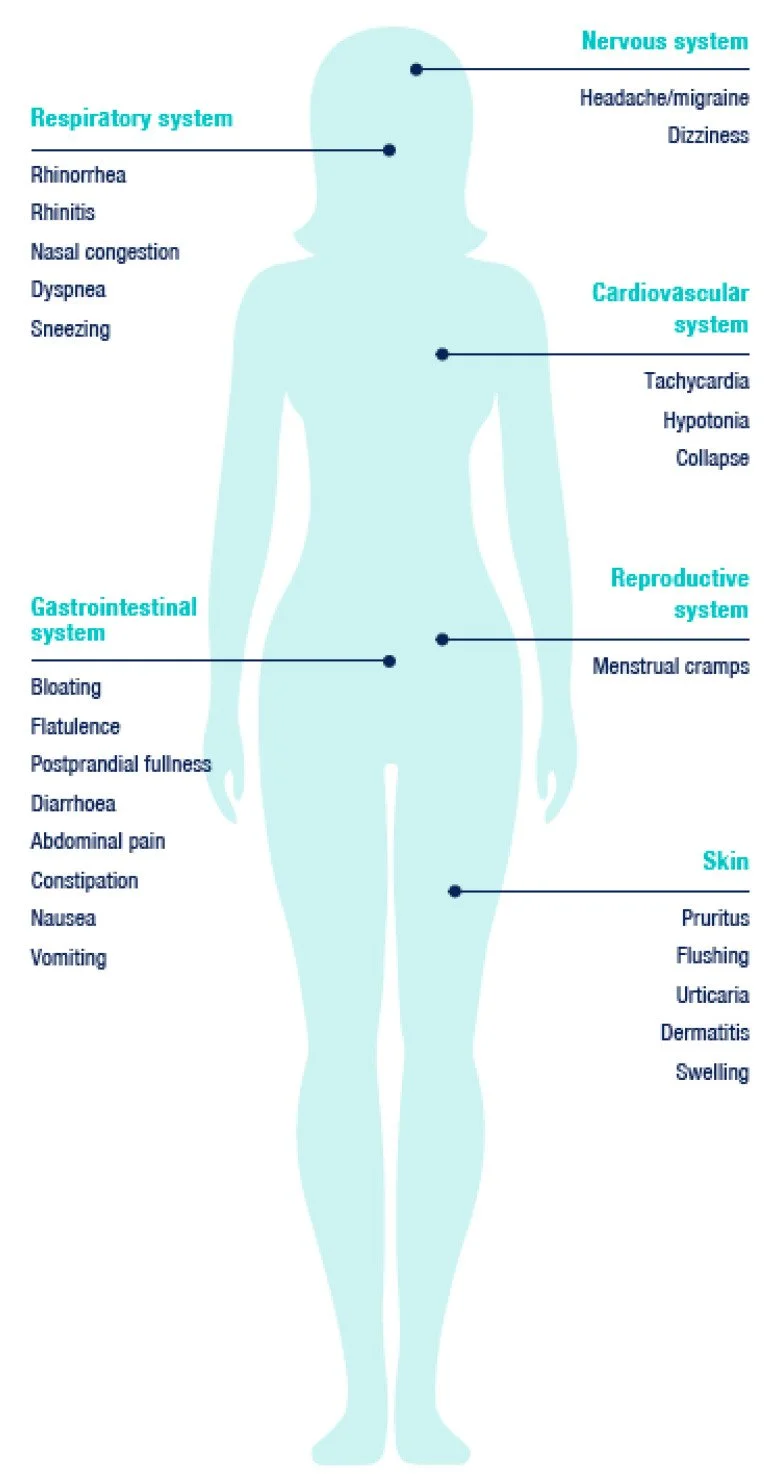
From: Histamine Intolerance—The More We Know the Less We Know. A Review, PMCID: PMC8308327 PMID: 34209583.
Causes of issues breaking down histamine:
Gut dysbiosis
Research shows an imbalanced gut microbiome can contribute to higher histamine levels. If you’re prone to IBS symptoms including bloating, pain, wind, constipation and diarrhoea, that could suggest that your gut microbiome needs some support.
Nutrient deficiencies
There’s a specific enzyme the body produces called DAO, which is essential to maintaining healthy levels of histamine in the body. DAO relies on nutrients including B6, vitamin D, zinc and magnesium, so if you’re deficient in those nutrients, you might not be producing DAO effectively.
Hormone imbalances & sluggish liver
Oestrogen and progesterone have an influence over the DAO enzyme, so you might notice symptoms are worse at certain points of your cycle. Histamine issues can also increase at menopause and around pregnancy due to the fluctuating hormone levels.
Your liver is also an important site for clearing out excess histamine, so if it’s a little slow (or sluggish) it might be affecting your levels.
Poor methylation
Methylation is an essential process in the body that influences how various systems in the body work, including your liver and detoxification pathways. Poor methylation can be genetic but can also be the result of nutrient deficiencies including B12, folate and B6.
Inflammation & autoimmunity
If your immune system is often in a heightened state due to autoimmunity or because of inflammation caused by stress, injury, illness, the likelihood is that your histamine levels will be higher. As I mentioned before, producing histamine is a natural part of the immune response, so where it’s more active, you’re likely to be producing more.
If any of that sounds familiar to you, it could be why you struggle more than others with hay fever - if you were to image a bucket of water, it’s as if it’s already 3/4 full with histamine issues before Spring comes around, then the environmental triggers push you to create more histamine (and struggle to remove it) that leads to an overflowing bucket and those constant allergy type symptoms.
Ways to help your body break down histamine:
Reduce histamine containing foods (this isn’t forever, it’s temporary whilst you get things a little more balanced): tomato, aubergines, white potato, avocado, cured meat, fermented foods, alcohol, caffeine, capiscum derived spices (paprika, cayenne, chilli powder), citrus fruits, peanuts.
Add in anti-inflammatory foods every day including red onion, red apples (eat the skin too), garlic, blueberries, raspberries, broccoli, turmeric, ginger & nettle tea.
Red onions contain high levels of quercetin (a potent mast cell stabiliser). Chop then mix into oil for a seasoning, or add into a quinoa, cucumber, feta, & mint salad.
Fresh ginger and turmeric are incredible to help modulate inflammation in the body - have in a tea, warm milk or add into a smoothie in the morning
Nettle tea can help to modulate the immune response, reducing histamine production - have 1-2 cups per day.
Lifestyle
Ensure to eat a varied diet containing lots of plant based foods - it might seem like I’ve said the opposite above, but there are plenty of other plant foods you can add in to help support your microbiome. Carrots, beetroot, rocket, sweet potato, kale, Swiss chard, quinoa, chickpeas, beans, lentils, berries, mango, edamame, cucumber.
Taking a bath in epsom salts helps to reduce stress, inflammation and can help the liver to work more effectively.
Work on reducing your stress levels. Stress is inflammatory, so find your methods to help you feel calmer; 5 deep breaths, yoga, reading, walking, spin, wherever you find your calm, do it every day.
To try to reduce irritation:
Splash your face with cold water as often as you need to remove any particles lingering around the nose and eyes.
I also use a misting spray on my face to help with dryness or itching - I’ve just got a small spray bottle and fill with water.
Nasal sprays can be a really effective way to create a barrier to prevent environmental particles from attaching to the nostrils, creating irritation. Pick one up from your local pharmacist.
When drying clothes, try to keep away from trees/plants/bushes that you know you are more sensitive to.
When you can, get to the coast and into the sea! This one is harder for those of us in the Midlands, but I often find that sea breeze helps to blow away triggering particles in the air, and, sea water is incredibly anti-inflammatory!
Nutrients to focus on (mentioned above and in supplements below)
Quercetin helps to reduce histamine
Vitamin C is incredibly important for reducing inflammation and supporting immune function
Zinc is also really important for immune function
B6 & Vitamin D helps DAO enzyme to function
Products I love to support hay fever/histamine symptoms:
BioCare’s Quercetin Complex
Zooki Liposomal Vitamin C
BioCare’s Nutrisorb Methyl B Complex
BioCare Nutrisorb D3
I hope you find this useful!
If you feel you’d benefit from 1:1 support to help with your histamine levels, please do reach out to hello@hannahmcmartin.co.uk explaining what you’re looking for support with and we’ll take it from there.
References:
Quercetin and Its Anti-Allergic Immune Response https://pubmed.ncbi.nlm.nih.gov/27187333/
Histamine Intolerance—The More We Know the Less We Know. A Review https://pmc.ncbi.nlm.nih.gov/articles/PMC8308327/